Jordan did almost everything right for retirement.
At age 51, the portfolio is substantial:
- $900,000 in a traditional IRA
- about $60,000 in taxable brokerage and cash
- no pension yet
- Social Security years away
Then Jordan gets laid off.
The problem is not total wealth.
It is access.
Most of the money sits inside a retirement account; Jordan is still more than eight years away from age 59½, and the taxable account is too small to fund the entire gap.
A Roth conversion ladder could help eventually, but a new ladder does not provide immediate access to converted money.
Jordan needs income now.
That is exactly the situation where a SEPP calculator becomes useful.
Rule 72(t), formally the substantially equal periodic payment exception, allows qualifying distributions before age 59½ without the usual 10% additional tax when the payment series follows the applicable IRS rules.
But there is not just one SEPP calculation.
There are three commonly used calculation methods:
- Required Minimum Distribution method
- Fixed Amortization method
- Fixed Annuitization method
And they can produce dramatically different payments from the exact same IRA.
In Jordan’s case, the difference is more than $33,000 per year.
Illustrative case: Jordan is a fictional persona used to demonstrate SEPP calculations. The figures are educational estimates. A substantially equal periodic payment series is highly sensitive to the account balance, interest rate, life expectancy table, payment timing, and future account activity. Consider having a qualified tax professional review the setup before the first distribution.
Quick Answer
Using Jordan’s:
- age: 51
- IRA balance: $900,000
- Single Life Table
- 5.23% illustrative permitted interest rate
- first payment beginning in August 2026
the three methods produce approximately:
| SEPP Method | Annual Payment | Monthly Equivalent |
|---|---|---|
| RMD Method | $25,496 | $2,125 |
| Fixed Amortization | $56,397 | $4,700 |
| Fixed Annuitization | $59,081 | $4,923 |
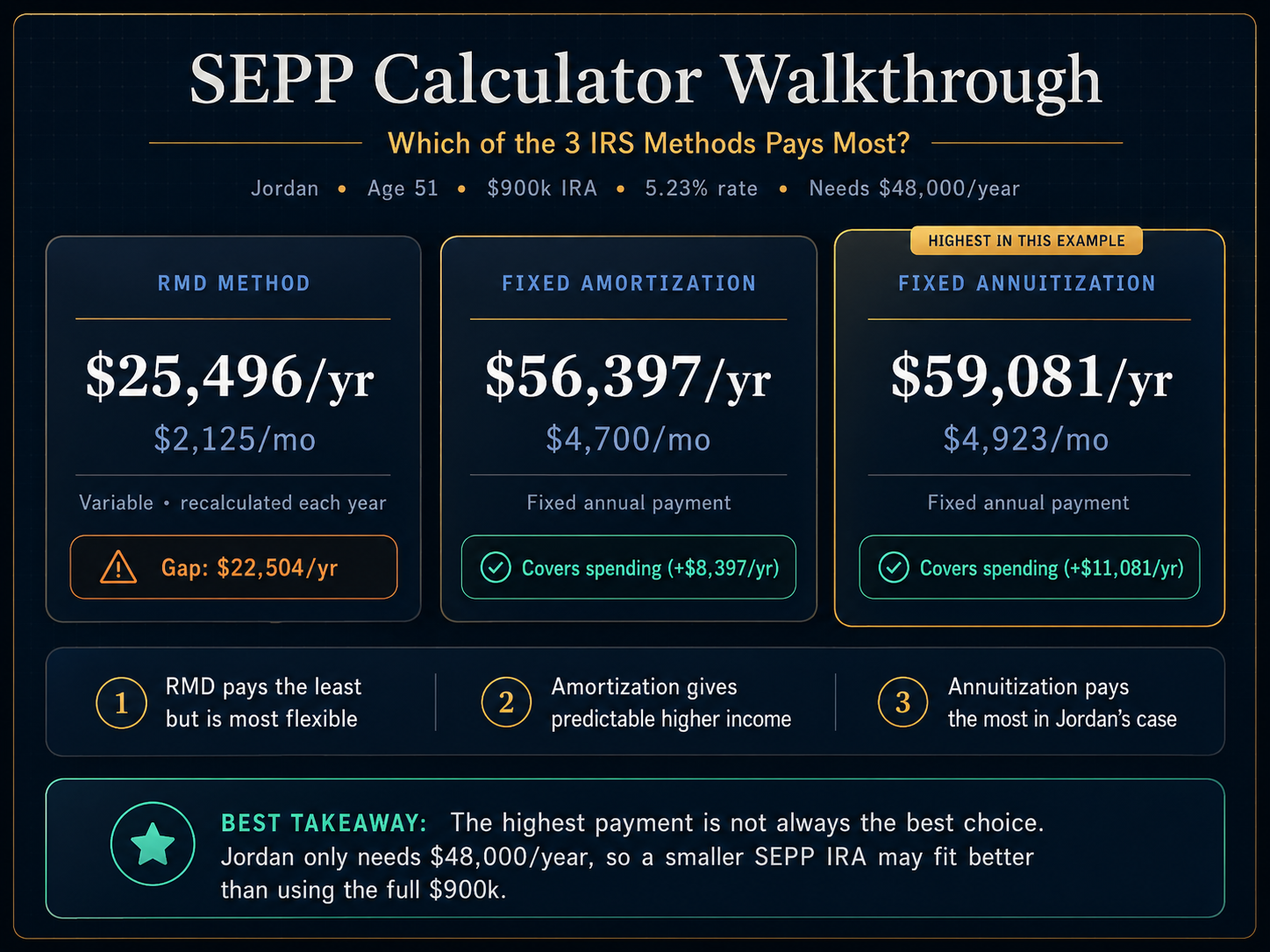
For this particular scenario:
Fixed Annuitization produces the highest payment.
Fixed Amortization is close behind.
The RMD method produces less than half the income of either fixed method.
But that does not mean Jordan should automatically choose annuitization.
Jordan only needs about $48,000 of IRA income.
A $59,000 mandatory distribution could create more taxable income than necessary every year and lock too much of the IRA into the SEPP arrangement.
The better question is not:
Which SEPP method pays the most?
It is:
Which method gives me the amount I actually need with the least unnecessary commitment?
That distinction matters enormously.
What Is a SEPP Calculator?
A SEPP calculator estimates substantially equal periodic payments under Section 72(t).
You generally enter:
- retirement-account balance
- age when payments begin
- selected life expectancy table
- permitted interest rate
- annual income need
The calculator then compares the payment amounts produced by the three calculation methods.
Unlike a standard retirement withdrawal calculator, a SEPP calculator is not asking:
“How much can I safely spend?”
It is calculating:
“What payment amount does this particular IRS methodology produce?”
Those are different questions.
A mathematically valid SEPP amount can still be too high for your tax strategy, too low for your spending needs, or too rigid for your retirement plan.
That is why the payment calculation should be viewed as one piece of the entire bridge.
Jordan’s Problem: $900k Saved, but Not Enough Accessible Money
Jordan is 51 and was expecting to work several more years.
Then a layoff changes the timeline.
Here is the starting position:
| Account | Balance |
|---|---|
| Traditional IRA | $900,000 |
| Taxable brokerage | $45,000 |
| Cash | $15,000 |
| Total | $960,000 |
Jordan expects approximately:
- $48,000 of annual core spending
- healthcare on top of that
- no immediate pension
- no significant earned income
The $60,000 of taxable assets could cover roughly one year of spending.
It cannot reasonably cover the full bridge from age 51 to 59½.
Why a Roth ladder does not solve the immediate problem
Jordan could begin Roth conversions now.
That may be an excellent long-term tax move.
But Jordan needs income now.
A newly established Roth conversion ladder requires time before converted amounts become useful as bridge assets.
That makes Jordan a much stronger candidate for evaluating Rule 72(t) than someone who already has five years of expenses sitting in taxable brokerage.
Compare Rule 72(t) vs. a Roth Conversion Ladder →
Step 1: Enter the IRA Balance
Jordan enters:
$900,000
This is not automatically every retirement dollar Jordan owns.
A SEPP calculation applies to the specific account used for the series.
That distinction creates an important planning opportunity: Jordan may not want to subject the entire $900,000 IRA to the SEPP arrangement.
Step 2: Enter Age 51
Jordan will be age 51 during the first distribution year.
Using the Single Life Table, the life expectancy factor for age 51 is:
35.3 years
For the RMD method, that factor directly determines the first-year distribution.
The Fixed Amortization calculation also uses the selected life expectancy period.
Age matters substantially.
Two people with identical account balances can receive different SEPP amounts because they begin the series at different ages.
Step 3: Determine the Permitted Interest Rate
This is one of the most important inputs in a SEPP calculator.
The RMD method does not use an interest-rate assumption in the same way.
Fixed Amortization and Fixed Annuitization do.
Under IRS Notice 2022-6, the selected rate cannot exceed the greater of:
- 5%, or
- 120% of the federal mid-term rate for either of the two months immediately preceding the month the first SEPP payment begins.
For an illustrative first distribution in August 2026:
- June 2026 annual 120% mid-term AFR: 4.97%
- July 2026 annual 120% mid-term AFR: 5.23%
Therefore the highest available rate from those two preceding months is:
5.23%
Jordan uses 5.23% for this walkthrough.
A lower permissible rate could also be selected.
And that matters because:
A higher rate generally produces a larger payment under the two fixed methods.
The SEPP rate is not a portfolio-return forecast.
Jordan is not claiming the IRA will actually earn 5.23%.
It is an input used in the SEPP calculation.
Run Jordan’s Numbers in the SEPP Calculator
Use these inputs:
- Account balance: $900,000
- Current age: 51
- Life expectancy: Single Life
- Interest rate: 5.23%
- Annual income need: $48,000
Method 1: Required Minimum Distribution
The RMD method is the simplest of the three.
For Jordan’s first year:
$900,000 ÷ 35.3 = approximately $25,496
That equals roughly:
$2,125 per month
Jordan needs about $48,000 of annual IRA income.
The first-year RMD payment therefore leaves an income gap of approximately:
$22,504
Why the RMD payment is so much lower
The method spreads the account across Jordan’s remaining life expectancy without incorporating the same fixed-interest calculation used by the other methods.
More importantly, the payment is recalculated each year.
The calculation uses:
- the applicable account balance
- Jordan’s updated age
- the corresponding life expectancy factor
That means the annual payment can change.
If the IRA falls sharply, the future RMD-method payment may decline.
If the account grows strongly, it may increase.
Best feature of the RMD method
It adapts to the account.
Biggest drawback for Jordan
It does not produce enough immediate income.
For someone trying to minimize mandatory taxable distributions, that can be a feature.
For someone who just lost a job and needs $48,000 per year, it may be a deal-breaker.
Method 2: Fixed Amortization
Fixed Amortization treats the IRA somewhat like a loan being amortized in reverse.
Jordan’s:
- $900,000 balance
- 35.3-year Single Life period
- 5.23% selected rate
produce an annual payment of approximately:
$56,397
Monthly equivalent:
$4,700
That is more than twice the first-year RMD amount.
It also exceeds Jordan’s $48,000 target by approximately:
$8,397 per year
Unlike the RMD method, the original Fixed Amortization payment remains fixed from year to year while Jordan remains on the method.
That predictability is attractive.
Jordan knows approximately how much IRA income will arrive each year.
But predictability cuts both ways.
If Jordan later:
- gets a new job
- dramatically reduces spending
- receives an inheritance
- wants less taxable income
- qualifies for a different healthcare strategy
the SEPP payment does not simply become optional.
The fixed payment is part of the commitment.
Method 3: Fixed Annuitization
Fixed Annuitization uses a mortality-based annuity factor rather than the simpler life-expectancy amortization formula.
Using Jordan’s:
- age 51
- $900,000 IRA
- 5.23% selected rate
- applicable mortality assumptions
the estimated annuity factor is approximately:
15.23
That produces an annual payment near:
$59,081
or approximately:
$4,923 per month
For Jordan, this is the largest of the three calculations.
It exceeds the Fixed Amortization result by roughly:
$2,685 per year
And it exceeds the first-year RMD amount by roughly:
$33,586 per year
So Which SEPP Method Pays the Most?
For Jordan:
1. Fixed Annuitization — about $59,081
2. Fixed Amortization — about $56,397
3. RMD — about $25,496 initially
That is the ranking for this specific set of inputs.
It should not be turned into a universal rule.
The payment depends on:
- age
- account balance
- selected life expectancy table
- permitted interest rate
- mortality assumptions
- starting date
The calculator exists precisely because the comparison can change.
Jordan’s Three Choices Side by Side
| Feature | RMD | Fixed Amortization | Fixed Annuitization |
|---|---|---|---|
| First-year payment | ~$25.5k | ~$56.4k | ~$59.1k |
| Monthly equivalent | ~$2,125 | ~$4,700 | ~$4,923 |
| Fixed annually? | No | Yes | Yes |
| Recalculated each year? | Yes | No | No |
| Uses interest rate? | No | Yes | Yes |
| Meets Jordan’s $48k target? | No | Yes | Yes |
| Highest payment in this example? | No | No | Yes |
The table makes one problem obvious.
Neither fixed method actually matches what Jordan needs.
Jordan needs approximately:
$48,000
But the two fixed methods produce:
- $56,397
- $59,081
Choosing the highest payment simply because it is highest could create unnecessary taxable income.
That leads to the most useful part of this walkthrough.
The Highest SEPP Payment Is Not Necessarily the Best SEPP Payment
Imagine Jordan chooses Fixed Annuitization on the full $900,000 IRA.
The annual distribution is approximately:
$59,081
But Jordan needs only about $48,000.
That is more than $11,000 of additional IRA income each year.
The extra money is not automatically harmful, but it could:
- increase federal taxable income
- increase state taxable income
- affect Marketplace healthcare calculations
- reduce room for Roth conversions
- create cash Jordan does not actually need
- force more of the IRA out during a market decline
SEPP is not a contest to withdraw the maximum possible amount.
The goal is to create the right amount of dependable bridge income.
A Better Move: Segment the IRA Before Starting SEPP
Jordan does not necessarily need to establish the SEPP on the entire $900,000.
Because the series applies to a specific account, Jordan could first divide the IRA into separate IRAs and then establish SEPP using only the account intended for the payment stream.
Suppose Jordan wants approximately:
$48,000 per year
Using the same Fixed Annuitization assumptions, the full $900,000 IRA produces about $59,081.
That means a smaller SEPP IRA of approximately:
$731,000
would produce roughly $48,000 under the same illustrative assumptions.
Jordan could potentially structure:
| IRA | Approximate Balance | Purpose |
|---|---|---|
| SEPP IRA | $731,000 | Generate ~$48k annual SEPP |
| Separate IRA | $169,000 | Remain outside this SEPP series |
| Total | $900,000 |
Now the payment is closer to the actual spending requirement.
And approximately $169,000 remains outside that particular SEPP arrangement.
That can be much more valuable than blindly maximizing the payment.
Timing matters
Any account restructuring should be completed and documented before establishing the SEPP.
Once the series has begun, additions, transfers, rollovers, or other changes involving the SEPP account can create serious problems.
This is an area where professional review before the first payment can be valuable.
Why Jordan Cannot Just Change the Payment Later
This is the part of Rule 72(t) that makes mistakes expensive.
A SEPP generally must continue until the later of:
- the fifth anniversary of the first payment, or
- reaching age 59½
Jordan is starting at 51.
That makes the age-59½ threshold the longer requirement.
Jordan is therefore committing to the arrangement for roughly eight and a half years.
If the series is improperly modified before the required date, the IRS can potentially impose:
- the 10% additional tax that had previously been avoided
- recapture on prior distributions
- interest
That is why the calculator output should be treated as a commitment decision rather than simply a withdrawal suggestion.
One Escape Valve: Fixed Method to RMD
There is one particularly useful rule.
Someone using:
- Fixed Amortization, or
- Fixed Annuitization
may make a one-time switch to the RMD method without that switch itself being treated as a prohibited modification.
After switching, the RMD method must continue.
Why might Jordan do this?
Imagine the market drops sharply three years into retirement.
Jordan is receiving a fixed $59,081 payment from an IRA that has fallen substantially.
Continuing that fixed withdrawal could accelerate depletion.
Switching once to RMD could lower future required distributions because the payment begins responding to the account balance again.
That flexibility makes the fixed methods less rigid than they first appear—but only in one direction.
Jordan cannot freely switch back and forth.
Can Jordan Take the Payment Monthly?
Yes.
The SEPP calculation determines an annual amount.
Subject to the custodian’s procedures, that annual amount can generally be distributed through installments such as:
- monthly
- quarterly
- annually
For example, Jordan’s approximate $56,397 Fixed Amortization result corresponds to:
about $4,700 per month
The key is that the total distributed during the applicable annual period matches the required amount.
The monthly schedule does not turn it into twelve separate SEPP calculations.
What About Ordinary Income Tax?
Rule 72(t) addresses the additional 10% tax.
It does not make traditional IRA distributions tax-free.
Jordan’s SEPP distributions are generally included in taxable income.
So:
$59,081 of SEPP income is not $59,081 of after-tax spending money.
Jordan still needs to consider:
- federal income tax
- state income tax
- Marketplace healthcare income
- capital gains
- dividends
- Roth conversions
- any future earned income
This is another reason choosing the largest payment can be counterproductive.
Jordan should model the after-tax household plan, not merely the SEPP amount.
SEPP vs. Roth Conversion Ladder for Jordan
Jordan originally hoped to use a Roth conversion ladder.
The ladder still has value.
But the immediate-access problem changes the order.
| Issue | SEPP | Roth Ladder |
|---|---|---|
| Income available immediately | Yes | No |
| Waiting period before newly converted dollars become bridge funds | No | Yes |
| Long-term payment commitment | Yes | No |
| Annual tax-planning flexibility | Lower | Higher |
| Useful with thin taxable account | Potentially | Difficult initially |
| Strong long-term tax tool | Moderate | Strong |
For Jordan, Rule 72(t) solves the immediate-access problem better.
A Roth ladder may still be layered into the broader tax strategy.
That is why this does not necessarily need to be an either/or decision.
Compare 72(t) and the Roth Conversion Ladder →
Run the Bridge Health Check Before Starting
Jordan’s SEPP amount should not be chosen in isolation.
Before committing, the full plan should answer:
- How many years must the bridge last?
- How much taxable money is available?
- Is $48,000 really the correct annual need?
- What happens to healthcare costs?
- What happens during a major early market decline?
- How much of the IRA should be used for SEPP?
- Should Roth conversions continue?
- What happens after age 59½?
The Bridge Health Check helps identify whether account access is actually the biggest weakness.
For Jordan, it probably is.
For someone with $500,000 in taxable assets and the same $900,000 IRA, the answer could be completely different.
That person may have no reason to accept a long SEPP commitment.
When the RMD Method Might Be Better
Jordan needs substantial immediate income, so RMD does not solve the problem.
But another retiree may prefer it.
Consider someone who:
- needs only $20,000–$25,000 of annual IRA income
- has some taxable brokerage
- wants withdrawals to adjust with the portfolio
- is worried about sequence risk
- does not want a large fixed taxable distribution
For that person, the lower payment can be an advantage.
“Pays least” does not mean “worst.”
The payment method should match the job.
When Fixed Amortization Might Be Better
Fixed Amortization can be attractive when:
- predictable income matters
- its payment is closer to the household’s actual need
- the investor prefers the life-expectancy-based calculation
- it avoids unnecessarily maximizing taxable income
In Jordan’s case:
- target income: ~$48,000
- amortization: ~$56,397
- annuitization: ~$59,081
Amortization still overshoots the target, but by less.
After IRA segmentation, either fixed method could potentially be sized to produce a more appropriate payment.
When Fixed Annuitization Might Be Better
Fixed Annuitization deserves consideration when:
- the household genuinely needs the larger payment
- the payment fits the tax plan
- the account can support it under weak-return scenarios
- the retiree understands the long commitment
For Jordan, the full-account annuitization result is approximately $59,081.
That might be appropriate if Jordan actually needs close to $60,000 of gross IRA income.
If Jordan needs only $48,000, the higher result becomes a reason to resize the SEPP account—not necessarily a reason to choose a different method.
What Jordan Should Document Before the First SEPP Payment
A SEPP is one of the retirement strategies where getting the setup wrong can create retroactive consequences.
Jordan should document:
- The exact IRA account used
- The valuation date and balance
- Age during the first distribution year
- Life expectancy table selected
- Permitted interest-rate source
- Interest rate actually used
- Method chosen
- Annual calculated payment
- Planned payment frequency
- Date of the first payment
- Earliest date the series can be modified
- Any IRA segmentation completed before the series begins
Those records should be kept for the life of the arrangement.
Jordan’s SEPP Walkthrough in One Table
| Input | Jordan |
|---|---|
| Age | 51 |
| Traditional IRA | $900,000 |
| Life table | Single Life |
| Life expectancy | 35.3 |
| First payment | August 2026 example |
| Maximum illustrative rate | 5.23% |
| Income target | $48,000 |
Results
| Method | Annual | Monthly | Difference vs. $48k Need |
|---|---|---|---|
| RMD | $25,496 | $2,125 | -$22,504 |
| Fixed Amortization | $56,397 | $4,700 | +$8,397 |
| Fixed Annuitization | $59,081 | $4,923 | +$11,081 |
Highest payment: Fixed Annuitization
Closest full-account fixed payment to Jordan’s target: Fixed Amortization
Lowest and variable: RMD
Potentially better solution: Segment the IRA and calculate a fixed payment on only the amount needed.
Bottom Line
A SEPP calculator does more than answer how much you can withdraw before age 59½.
It shows how dramatically the calculation method can change the result.
For Jordan, age 51 with a $900,000 IRA:
- RMD produces about $25,500
- Fixed Amortization produces about $56,400
- Fixed Annuitization produces about $59,100
So in this scenario, Fixed Annuitization pays the most.
But that is not the most important conclusion.
Jordan only needs about $48,000.
The highest possible payment would create more mandatory taxable income than the plan requires.
A better solution may be to isolate a smaller IRA for the SEPP, calculate the payment on that account, and leave the remaining retirement assets outside the series.
That is the real value of a substantially equal periodic payments calculator.
It does not merely tell you:
How much can I take?
Used properly, it helps answer:
How much should I commit to taking—and how much of my retirement account should I commit to the strategy?
Compare all three SEPP methods with your numbers →
Frequently Asked Questions
What is a SEPP calculator?
A SEPP calculator estimates substantially equal periodic payments under the Rule 72(t) exception using the RMD, Fixed Amortization, and Fixed Annuitization calculation methods.
Which SEPP method pays the most?
There is no universal winner. In Jordan’s age-51, $900,000 example, Fixed Annuitization produces the highest payment at approximately $59,081 per year, followed by Fixed Amortization at approximately $56,397.
Why is the RMD SEPP payment so much lower?
The RMD method divides the account balance by a life expectancy factor and recalculates the result annually. The fixed methods incorporate a permitted interest-rate assumption and generally produce substantially larger initial payments.
What interest rate can I use for a SEPP in 2026?
Under Notice 2022-6, the rate used for Fixed Amortization or Fixed Annuitization cannot exceed the greater of 5% or 120% of the federal mid-term rate for either of the two months immediately preceding the month the first payment begins. The exact limit therefore depends on the SEPP start month.
What is the maximum rate for an August 2026 SEPP start?
Using the annual 120% federal mid-term AFRs for June and July 2026, the higher preceding-month rate is 5.23% for July. Therefore 5.23% is the maximum rate used in this walkthrough.
Does a higher SEPP interest rate mean my investments are expected to earn that amount?
No. The interest rate is an input to the fixed SEPP calculation. It is not an assumed or guaranteed investment return.
How long would Jordan’s SEPP need to continue?
Because Jordan begins at age 51, the age-59½ requirement is longer than five years. The series generally needs to remain compliant until Jordan reaches age 59½.
Can Jordan stop SEPP after five years?
Not if Jordan has not yet reached age 59½. The general duration requirement is the later of the fifth anniversary of the first payment or age 59½.
Can a SEPP payment be taken monthly?
The annual amount may generally be divided into installments, subject to the custodian’s procedures. The total annual distributions must still match the required amount.
Can Jordan switch SEPP methods later?
A one-time switch from Fixed Amortization or Fixed Annuitization to the RMD method is permitted under Notice 2022-6 without that switch itself being treated as a prohibited modification. Switching back is not permitted under that special rule.
Can I use only part of my IRA for SEPP?
A SEPP applies to a specific retirement account. Someone with a large IRA may be able to split assets into separate IRAs before establishing the series and use only one account for SEPP. The restructuring and documentation should be completed before the first payment and reviewed carefully.
Are SEPP withdrawals tax-free?
No. The SEPP exception generally avoids the 10% additional tax on qualifying early distributions. Taxable traditional IRA distributions are still generally included in ordinary income.
Is Rule 72(t) better than a Roth conversion ladder?
It depends on the problem. SEPP provides immediate retirement-account access but creates a long payment commitment. A Roth conversion ladder provides greater long-term flexibility but generally requires a waiting period before newly converted dollars can serve as bridge funds.
Source Notes
IRS — Substantially Equal Periodic Payments https://www.irs.gov/retirement-plans/substantially-equal-periodic-payments
Supports the three calculation methods, SEPP requirements, duration rules, installment payments, recapture consequences, and the one-time switch to RMD.
IRS Notice 2022-6 https://www.irs.gov/pub/irs-drop/n-22-06.pdf
Supports the current SEPP methodology, permitted life expectancy tables, interest-rate rules, account-balance requirements, modification rules, and fixed-method-to-RMD switch.
IRS Rev. Rul. 2026-11 — June 2026 Applicable Federal Rates
https://www.irs.gov/pub/irs-drop/rr-26-11.pdf
Table 1 shows the June 2026 annual 120% federal mid-term rate of 4.97% used in the August 2026 SEPP rate comparison.
IRS Rev. Rul. 2026-12 — July 2026 Applicable Federal Rates
https://www.irs.gov/pub/irs-drop/rr-26-12.pdf
Table 1 shows the July 2026 annual 120% federal mid-term rate of 5.23%, the higher of the two preceding-month rates used in this walkthrough.
IRS — Applicable Federal Rates https://www.irs.gov/applicable-federal-rates
Supports monthly federal mid-term rates used when determining the allowable SEPP calculation rate.
IRS Publication 590-B https://www.irs.gov/publications/p590b
Supports IRA distribution taxation and early-distribution rules.