Sam is 52 and burned out.
The job pays well. The retirement accounts look healthy. The spreadsheet says retirement is getting close.
But there is one question Sam cannot stop thinking about:
Should I retire at 55, or push through until 57?
Two years does not sound like much.
When you are already exhausted, however, two more years can feel enormous.
And financially, those two years can be worth much more than two additional years of salary.
They can mean:
- two more years of contributions
- two more years of portfolio growth
- two fewer years that the portfolio must support
- two fewer years of pre-59½ bridge funding
- two fewer years of self-funded healthcare before Medicare
- a lower initial portfolio draw
- substantially more room for a bad market early in retirement
That is what makes the retire at 55 vs. 57 decision more complicated than simply asking which age produces the larger portfolio.
The better question is:
What exactly do two extra working years buy—and is that extra financial margin worth the time?
This walkthrough compares both options.
Illustrative case: Sam is a fictional example. Returns, healthcare costs, taxes, inflation, and future spending are uncertain. The numbers below are planning estimates designed to show how a retirement-age decision can change the structure of an early-retirement bridge.
Quick Answer
Using the assumptions in this example, Sam could potentially make retirement at 55 work.
But the margin is thin.
Waiting until 57 changes the picture dramatically.
| Retire at 55 | Retire at 57 | |
|---|---|---|
| Projected portfolio | ~$1.394M | ~$1.659M |
| Projected taxable brokerage | ~$354k | ~$449k |
| Years to age 59½ | 4.5 years | 2.5 years |
| Access-first bridge target with 15% buffer | ~$342k | ~$190k |
| Taxable cushion above target | ~$12k | ~$259k |
| $66k initial portfolio draw | ~4.74% | ~3.98% |
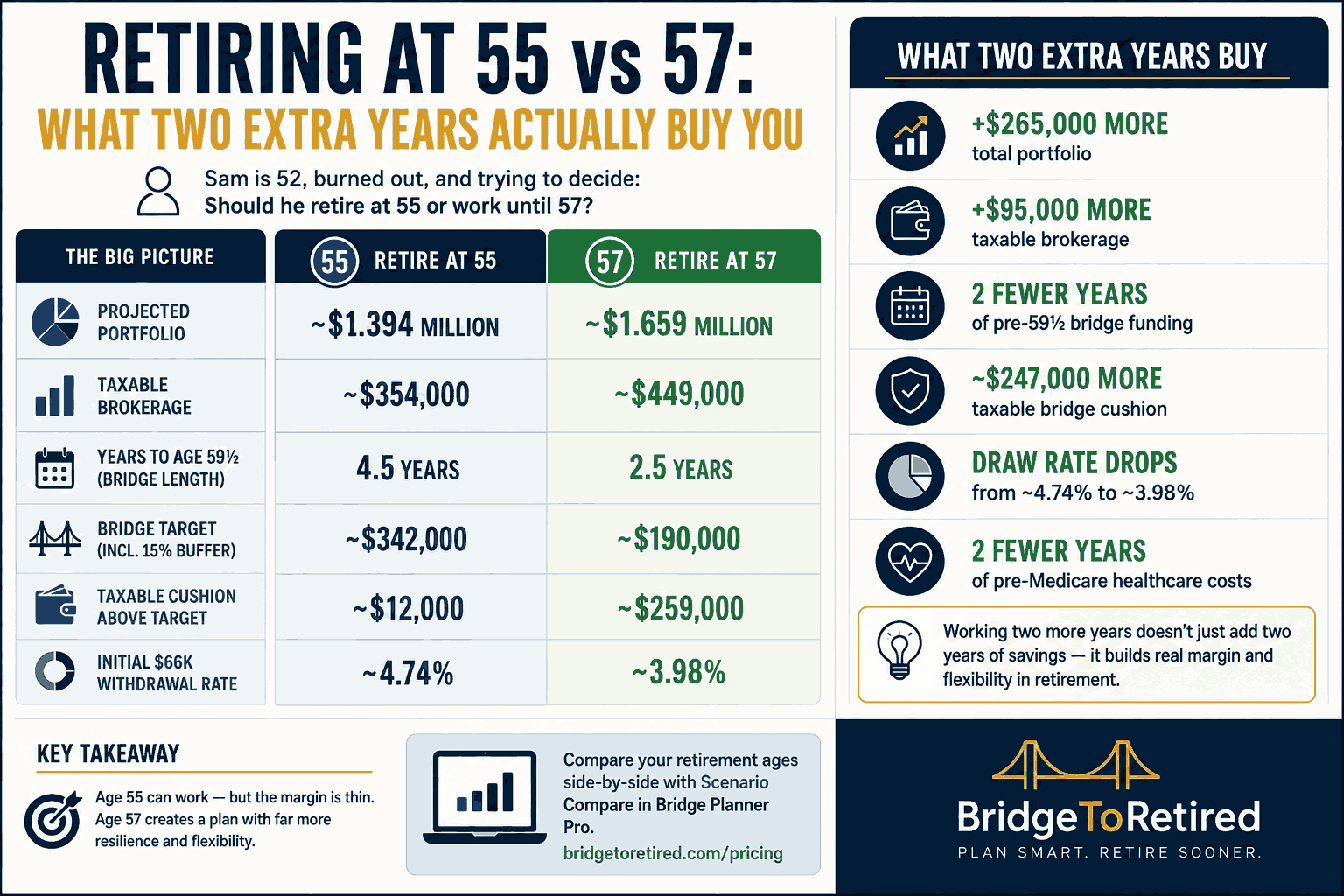
In this illustration, working two additional years gives Sam approximately^^^
- $265,000 more total portfolio
- $95,000 more taxable brokerage
- $152,000 less bridge funding required
- roughly $247,000 more taxable bridge cushion
- an initial portfolio draw that falls from about 4.74% to 3.98%
That does not automatically mean 57 is the correct answer.
It means age 57 buys something very specific:
margin.
And margin can be extremely valuable during the first years of retirement.
Sam's Starting Point at Age 52
Sam has spent more than 20 years climbing into management.
The compensation is good.
The stress is not.
At age 52, Sam has:
| Account | Balance |
|---|---|
| Taxable brokerage | $230,000 |
| Retirement accounts and Roth | $820,000 |
| Total portfolio | $1,050,000 |
Sam currently saves approximately:
$45,000 per year
Of that:
- $25,000 goes into taxable brokerage
- $20,000 goes into retirement accounts
Sam expects retirement spending of approximately:
$55,000 per year
Healthcare before Medicare adds another estimated:
$11,000 per year
That creates an initial planning target of:
$66,000 per year
The $11,000 healthcare figure is only a planning assumption. Actual Marketplace premiums and out-of-pocket costs can vary substantially based on location, age, household income, plan selection, and eligibility for premium assistance.
Marketplace coverage can be used by retirees before Medicare begins.
HealthCare.gov — Health Coverage for Retirees
For the accumulation projections in this example, we will use:
- 6% annual portfolio growth
- $45,000 annual contributions
- $25,000 of those contributions directed to taxable brokerage
- contributions modeled at year-end for simplicity
- no inflation adjustment in the headline comparison
These are illustrative assumptions, not return forecasts.
First, Run the Early Retirement Age Calculator
Before Sam chooses 55 or 57, it helps to establish whether retirement is even within range.
An early retirement calculator can answer the first question:
When could my portfolio plausibly support retirement?
But that is not the same as answering:
Which retirement age gives me enough accessible money and enough margin to feel comfortable leaving work?
That second question requires looking at the bridge.
And that is where age 55 and age 57 begin to look very different.
Option 1: Sam Retires at 55
Sam has three more working years.
Starting with $1.05 million, adding $45,000 per year, and assuming 6% annual growth produces a projected portfolio at 55 of approximately:
$1.394 million
The taxable brokerage account grows from $230,000 to approximately:
$354,000
That sounds strong.
And it is.
But total portfolio size is only part of the retirement problem.
Sam still needs to get from age 55 to the point where retirement-account access becomes easier.
For many retirement accounts, distributions before age 59½ can face an additional 10% tax unless an exception applies.
IRS — Exceptions to Tax on Early Distributions
That leaves Sam with roughly:
4.5 bridge years
Using the $66,000 annual planning need:
$66,000 × 4.5 years = $297,000
Add a 15% planning buffer:
$341,550
Sam's projected taxable brokerage is approximately $353,500.
So the taxable-only bridge looks funded.
But barely.
The cushion is only about:
$12,000
That is the problem with looking only at the headline $1.394 million portfolio.
Sam may be a millionaire and still have a fragile bridge.
The Age-55 Plan Works—but It Does Not Have Much Room for Error
At 55, Sam's numbers are not obviously bad.
The problem is how many things must cooperate.
A $12,000 taxable cushion can disappear quickly if:
- healthcare costs come in higher
- the market falls shortly before retirement
- a major home repair appears
- Sam spends more than expected
- taxes are higher than modeled
- the taxable portfolio underperforms
- inflation pushes annual spending higher
Retirement at 55 is therefore not necessarily a no.
It is closer to:
Yes, but the plan needs discipline and contingencies.
That distinction matters.
Sam's decision is not between “financially independent” and “broke.”
It is between a plan with relatively little margin and a plan with considerably more.
Option 2: Sam Works Until 57
Now add two more working years.
Sam continues contributing $45,000 annually.
The portfolio continues compounding.
Under the same 6% illustration, the total portfolio grows to approximately:
$1.659 million
Projected taxable brokerage reaches approximately:
$449,000
Sam now retires only 2.5 years before age 59½.
The baseline bridge requirement becomes:
$66,000 × 2.5 = $165,000
With the same 15% buffer:
$189,750
Against approximately $448,700 of taxable assets, Sam now has a bridge cushion of roughly:
$259,000
That is an entirely different retirement structure.
At age 55, taxable assets roughly match the bridge target.
At age 57, taxable assets exceed it by more than a quarter-million dollars.
What Did Those Two Years Actually Buy?
This is the part that is easy to underestimate.
Sam did not simply earn two more paychecks.
The two years changed several variables at the same time.
1. About $265,000 More Total Portfolio
Projected portfolio at 55:
~$1.394 million
Projected portfolio at 57:
~$1.659 million
Difference:
~$265,000
Only $90,000 of that comes from the two additional $45,000 annual contributions.
The rest comes largely from allowing an already substantial portfolio more time to compound under the assumptions used here.
The larger the portfolio becomes, the more valuable an additional year of compounding can become.
2. About $95,000 More Taxable Brokerage
At age 55:
~$354,000
At age 57:
~$449,000
Difference:
~$95,000
This matters because taxable brokerage is not merely another investment account in early retirement.
It is flexibility.
It can help fund:
- normal living expenses
- healthcare
- taxes
- unexpected costs
- Roth conversions
- years when selling from retirement accounts would be undesirable
For Sam, additional taxable assets make the bridge much less dependent on everything going according to plan.
3. The Bridge Gets Two Years Shorter
This may be even more important than the extra $95,000.
Retiring at 55 requires approximately:
4.5 years to age 59½
Retiring at 57 requires approximately:
2.5 years
At $66,000 per year, those two years represent:
$132,000 of spending
After applying the same 15% planning buffer, the modeled bridge target drops by approximately:
$152,000
This is why working longer can improve a bridge faster than people expect.
You are simultaneously adding assets and removing years that need funding.
4. The Initial Portfolio Draw Falls Below 4%
Sam's $66,000 annual need represents approximately:
Age 55
$66,000 ÷ $1.394M ≈ 4.74%
Age 57
$66,000 ÷ $1.659M ≈ 3.98%
This is not a declaration that one withdrawal rate is “safe” and another is “unsafe.”
Retirement sustainability depends on far more than one percentage.
But the comparison shows something useful.
At 57, the portfolio has to do less work immediately.
Sam is beginning retirement with more assets and the same assumed spending.
That creates more room to respond when reality differs from the spreadsheet.
5. Two Fewer Years of Pre-Medicare Healthcare
Healthcare is one of the most overlooked costs in early retirement.
Sam's example assumes $11,000 annually before Medicare.
Retiring at 55 means roughly ten years before age 65.
Retiring at 57 means roughly eight.
At today's assumed $11,000 annual cost, those two years alone represent approximately:
$22,000
before considering inflation, premium assistance, changing household income, or changes in actual medical expenses.
Marketplace coverage can bridge the period before Medicare, and household income can affect eligibility for premium savings.
HealthCare.gov — Save on Monthly Health Insurance Premiums
6. Sam Gets More Protection From Sequence Risk
Suppose Sam retires at 55 and the market falls sharply during the first year.
The plan already begins with a relatively narrow taxable cushion.
That creates more pressure.
Sam may need to:
- reduce discretionary spending
- delay large purchases
- use taxable cash reserves
- change the timing of Roth conversions
- reconsider where withdrawals come from
At 57, the same market decline would still hurt.
But Sam would begin with:
- a larger portfolio
- a much larger taxable account
- a shorter bridge
- a lower initial draw
The market decline has not changed.
Sam's ability to absorb it has.
That is what retirement resilience looks like.
But There Is an Important Age-55 Exception
Age 55 has one potentially important advantage.
Under current federal tax rules, certain distributions from a qualified employer retirement plan may avoid the additional 10% early-distribution tax when separation from service occurs during or after the calendar year in which the employee reaches age 55.
The exception generally applies to qualifying employer plans rather than IRAs.
IRS — Exceptions to Tax on Early Distributions
This is often called the Rule of 55.
So Sam may have another source of retirement-account access at age 55 depending on:
- which account holds the money
- when employment ends
- the employer plan's distribution rules
- whether the assets remain in the qualifying employer plan
That can materially change an age-55 retirement strategy.
But I would not automatically count the entire employer retirement account as bridge money.
Taxable brokerage still provides something valuable:
optionality.
Sam can choose when to realize gains, when to withdraw from the employer plan, and how to coordinate income with other tax decisions.
The age-55 exception can be part of the plan without becoming the entire plan.
What Happens if Returns Are Lower?
A retirement decision should not depend on one 6% projection.
So let's weaken the accumulation assumption.
If Sam Earns Only 3% Before Retirement
| Retire at 55 | Retire at 57 | |
|---|---|---|
| Projected portfolio | ~$1.286M | ~$1.456M |
| Projected taxable brokerage | ~$329k | ~$399k |
| Bridge target with 15% buffer | ~$342k | ~$190k |
| Taxable surplus/(gap) | ~-$13k | ~+$210k |
Now age 55 slips slightly below the taxable bridge target.
Age 57 still has substantial room.
If There Is No Portfolio Growth at All Before Retirement
Sam would have approximately:
| Retire at 55 | Retire at 57 | |
|---|---|---|
| Total portfolio | $1.185M | $1.275M |
| Taxable brokerage | $305k | $355k |
| Bridge surplus/(gap) | ~-$37k | ~+$165k |
This stress test reveals the core tradeoff.
Age 55 works much better when markets cooperate.
Age 57 relies less heavily on that assumption.
That does not make 57 automatically better.
It makes it more robust.
When Retiring at 55 Could Still Be the Right Decision
Sam should not work two extra years solely because a spreadsheet produces a larger number.
Money has a purpose.
The purpose is not to maximize the account balance indefinitely.
Retiring at 55 may still be reasonable if:
- Sam genuinely values those two years more than the additional financial margin
- spending can be reduced during weak markets
- part-time work is realistic
- healthcare costs are manageable
- the Rule of 55 provides appropriate account access
- taxable assets are sufficient
- Sam has a meaningful cash reserve
- major expenses are already funded
- the overall plan performs adequately under weaker scenarios
There is a point where more financial security produces diminishing lifestyle value.
Sam's task is figuring out where that point is.
When Working Until 57 Is Probably Worth It
Age 57 becomes compelling when the age-55 plan requires too many optimistic assumptions.
For example:
“I can retire at 55 as long as the market returns 6%, healthcare stays near $11,000, I never exceed my spending target, and nothing expensive breaks.”
That is not much of a margin.
Compare it with:
“I can retire at 57 even if returns disappoint, healthcare runs high, or I need an extra $20,000 one year.”
That second plan buys something beyond a larger portfolio.
It buys freedom from having to optimize every decision.
And that psychological difference may matter almost as much as the mathematical one.
Check the Retirement Readiness Score
Sam's age-55 scenario is a good example of why a single portfolio number can be misleading.
A $1.394 million projected portfolio sounds comfortable.
But the bridge analysis reveals:
- only about $354,000 projected taxable
- approximately $342,000 of buffered bridge need
- a relatively high initial draw
- substantial healthcare years remaining
- limited room for poor early returns
That is exactly the kind of plan where a broader readiness check can expose weaknesses that a FIRE number alone misses.
Check your Retirement Readiness Score →
Compare Age 55 and 57 Side by Side
Sam is no longer trying to answer:
Can I retire?
Both scenarios may be viable.
The real question is:
What am I receiving in exchange for two more years of work?
For Sam, the answer is roughly:
| Two Extra Years Buy | Approximate Impact |
|---|---|
| Additional total portfolio | +$265k |
| Additional taxable assets | +$95k |
| Reduction in buffered bridge requirement | -$152k |
| Improvement in taxable bridge cushion | ~+$247k |
| Initial draw | 4.74% → 3.98% |
| Bridge length | 4.5 yrs → 2.5 yrs |
This is where comparing retirement scenarios becomes more useful than running one calculator repeatedly.
A side-by-side comparison can show whether another year of work materially improves:
- portfolio longevity
- accessible assets
- withdrawal pressure
- sequence risk
- tax flexibility
- healthcare funding
- long-term funded status
BridgeToRetired Online Pro includes Scenario Compare for modeling different retirement ages and assumptions side by side.
Compare retirement scenarios with Pro →
So Should Sam Retire at 55 or 57?
There is no universal answer.
At 55, Sam has approximately:
- $1.394 million projected total portfolio
- $354,000 taxable
- a 4.5-year bridge
- roughly $12,000 of taxable cushion above the buffered bridge target
The plan appears possible.
But the margin is narrow.
At 57, Sam has approximately:
- $1.659 million projected total portfolio
- $449,000 taxable
- a 2.5-year bridge
- roughly $259,000 of taxable cushion
The plan changes from:
This can probably work.
to something closer to:
This has room for life to happen.
That is what two additional years actually buy.
The Bigger Lesson: Retirement Age Is a Lever
People often treat retirement age as the answer produced at the end of a calculation.
It is more useful to think of retirement age as a planning lever.
Moving it even one year can affect several things simultaneously:
- portfolio value
- contributions
- taxable brokerage
- bridge length
- healthcare years
- withdrawal rate
- Social Security timing options
- Roth conversion opportunities
- sequence risk
That is why asking “When can I retire?” is only the beginning.
A better question is:
At what age does the plan become resilient enough that the additional financial benefit of working longer is no longer worth the time?
For one person, that may be 55.
For another, 57.
For someone else, it may be 53 or 60.
The goal is not to find the age with the largest portfolio.
The goal is to find the earliest age where the entire retirement bridge works with a level of risk you are willing to accept.
Bottom Line
For Sam, two extra working years create a surprisingly large difference.
Using the assumptions in this example:
Retire at 55
- ~$1.394M portfolio
- ~$354k taxable brokerage
- 4.5-year bridge
- ~$342k buffered bridge target
- ~$12k taxable cushion
- ~4.74% initial portfolio draw
Retire at 57
- ~$1.659M portfolio
- ~$449k taxable brokerage
- 2.5-year bridge
- ~$190k buffered bridge target
- ~$259k taxable cushion
- ~3.98% initial portfolio draw
Age 55 is not necessarily too early.
Age 57 is not automatically better.
But the two years buy far more than $90,000 of additional contributions.
They buy additional compounding, a shorter bridge, more accessible money, a lower initial draw, and considerably more protection against an imperfect retirement.
That is the real retirement-age comparison.
The question is not simply whether Sam can retire at 55.
It is whether the extra resilience available at 57 is worth two more years of work.
Frequently Asked Questions
Is 55 a Realistic Age to Retire?
It can be.
The answer depends on spending, accessible assets, healthcare, taxes, account types, retirement-account access, and how the portfolio performs under weak-market scenarios.
Total net worth alone is not enough to determine whether age 55 works.
Is Retiring at 57 Much Safer Than Retiring at 55?
Not automatically.
But two additional years can improve several variables simultaneously.
In Sam's illustration, the portfolio grows, taxable assets increase, the bridge becomes two years shorter, and the initial portfolio draw declines.
How Much Difference Can Two More Years of Work Make?
In Sam's example, approximately $90,000 of additional contributions plus assumed investment growth increase the projected portfolio by about $265,000 between age 55 and 57.
The other major benefit is that the bridge requirement falls because retirement begins two years later.
Can I Use My 401(k) if I Retire at 55?
Potentially.
Current IRS rules include an exception to the additional 10% early-distribution tax for certain qualified employer-plan distributions following separation from service in or after the year the employee reaches age 55.
The exception generally does not apply the same way to IRAs, and employer-plan rules matter.
IRS — Exceptions to Tax on Early Distributions
How Much Taxable Brokerage Should I Have Before Retiring at 55?
There is no single percentage that works for everyone.
Start by estimating the years that must be funded before easier retirement-account access, multiply by expected annual spending, account for taxes and healthcare, and add a contingency buffer.
Then consider any other penalty-free account-access strategies available to you.
What if Investment Returns Are Lower Before I Retire?
That is exactly why comparing multiple return assumptions matters.
In this example, lowering pre-retirement growth from 6% to 3% turns Sam's age-55 taxable cushion into a small shortfall, while the age-57 scenario still retains significant margin.
When Can I Retire if Age 55 Looks Too Tight?
Do not immediately assume you need five or ten additional working years.
Test 56, 57, and 58 individually.
Retirement readiness can improve quickly because each additional year can add contributions and growth while simultaneously shortening the number of years the portfolio must fund.
Source Notes
IRS — Retirement Topics: Exceptions to Tax on Early Distributions
Supports the general age-59½ rule and the separation-from-service exception for certain qualified employer plans.
https://www.irs.gov/retirement-plans/plan-participant-employee/retirement-topics-exceptions-to-tax-on-early-distributions
IRS — Topic No. 558: Additional Tax on Early Distributions
Supports the general treatment of certain retirement-plan distributions before age 59½.
https://www.irs.gov/taxtopics/tc558
HealthCare.gov — Health Coverage for Retirees
Supports the use of Marketplace coverage by retirees before Medicare begins.
https://www.healthcare.gov/retirees/
HealthCare.gov — Save on Monthly Health Insurance Premiums
Supports the relationship between household income and potential Marketplace premium savings.
https://www.healthcare.gov/lower-costs/save-on-monthly-premiums/
Medicare.gov — When Does Medicare Coverage Start?
Supports the general age-65 Medicare enrollment timeline used in the healthcare discussion.
https://www.medicare.gov/basics/get-started-with-medicare/sign-up/when-does-medicare-coverage-start