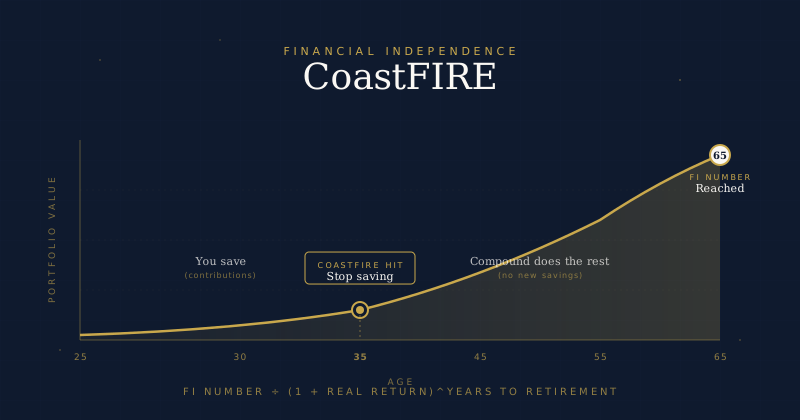
CoastFIRE is the financial independence milestone most people underestimate.
It is the point where your portfolio is large enough that compound growth alone will carry it to a full retirement number by traditional retirement age — even if you never contribute another dollar. No more 401(k) contributions required. No more pressure to max out your Roth IRA. Just enough current income to cover today's expenses, and time does the rest.
CoastFIRE does not mean you retire today. It means the retirement question is solved. You are free to downshift, switch to a lower-paying job you actually enjoy, start a business, go part-time, or take extended time off — because your retirement nest egg no longer needs you.
This guide explains exactly what CoastFIRE is, the formula to calculate your number, how it compares to regular FIRE and BaristaFIRE, and where it fits into a broader early retirement plan.
Quick Answer
CoastFIRE is the point at which your invested assets will grow to your full retirement number by traditional retirement age (typically 65) through compound interest alone — with zero additional contributions.
The formula:
CoastFIRE Number = FI Number ÷ (1 + real return rate)^years until retirement
Where FI Number = annual retirement spending × 25 (the inverse of the 4% rule).
Once you hit your CoastFIRE number, you only need to earn enough to cover current living expenses. The retirement portfolio handles itself.
The CoastFIRE Formula, Step by Step
CoastFIRE uses two layered formulas. You calculate your full FI number first, then discount it back to today.
Step 1: Calculate Your Full FI Number
Your FI number is the total portfolio balance you need at retirement to live off investment returns without running out. Using the 4% rule:
FI Number = Annual Retirement Spending × 25
Example: If you expect to spend $60,000 per year in retirement:
- FI Number = $60,000 × 25 = $1,500,000
🔢 Calculate your FI number: Use the FIRE Number Calculator to find your exact retirement target based on spending, withdrawal rate, and timeline.
Step 2: Discount That Back to Today
Now you need to figure out how much you need today so that compound growth alone will reach that $1.5M by retirement age.
CoastFIRE Number = FI Number ÷ (1 + real return)^years
Example: You're 35 today and want to retire at 65 (30 years away). Using a 7% real return:
- $1,500,000 ÷ (1.07)^30
- $1,500,000 ÷ 7.612
- ~$197,000
If you have $197,000 invested at age 35, you can stop contributing to retirement accounts forever and compound interest will grow it to $1.5M by 65.
That is the entire math behind CoastFIRE.
Your CoastFIRE Number by Age
Here's how much you need invested today to coast to a $1.5M retirement at age 65, assuming 7% real returns:
The pattern is brutal but clear: compound interest rewards starting early. A 25-year-old needs $100k. A 45-year-old needs nearly 4× that. A 55-year-old needs almost 8× that.
This is why CoastFIRE resonates so strongly with people in their 20s and 30s — it is the one financial independence milestone that is dramatically easier for younger savers than older ones.
How to Calculate Your CoastFIRE Gap
Your CoastFIRE gap is the difference between what you have invested today and your CoastFIRE number.
CoastFIRE Gap = CoastFIRE Number − Current Invested Assets
If your CoastFIRE number is $276,000 and you have $200,000 invested, your gap is $76,000. That is how much more you need invested before you can stop aggressively saving for retirement.
The gap tells you two things:
- How close you are to the milestone — a $76,000 gap at a $25,000/year contribution rate is roughly 2–3 years away (factoring in market growth).
- Whether CoastFIRE is realistic on your timeline — if your gap is $400,000 and you can only save $15,000/year, CoastFIRE may be a decade out. That is still useful information — but it means CoastFIRE is a future milestone, not a current decision.
Important: the gap does not tell you whether you can quit your job. It only tells you whether you can stop contributing to retirement accounts. You still need current income unless you have reached full FIRE or BaristaFIRE.
CoastFIRE vs FIRE vs BaristaFIRE
The three most common FIRE variants are often conflated, but they describe very different financial situations.
The key distinction: CoastFIRE does not let you stop working. It lets you stop saving. Everything else flows from that.
🎯 Grade your current plan: The Retirement Readiness Score scores your bridge plan across withdrawal rate, account access, healthcare, and sequence risk — useful whether you're at CoastFIRE or still building toward it.
CoastFIRE vs BaristaFIRE: The Key Difference
CoastFIRE and BaristaFIRE often get confused because they both sit between "aggressive saver" and "fully retired." But the mechanics are completely different.
CoastFIRE means your retirement portfolio is large enough that compound growth alone will carry it to your FI number by traditional retirement age. You stop contributing to retirement accounts, but you still work enough to cover current living expenses. Your portfolio is untouched.
BaristaFIRE means you have left full-time work earlier than traditional retirement age and you supplement a partial portfolio withdrawal with part-time income — often specifically for healthcare benefits (hence the name, referencing Starbucks' part-time benefits). Your portfolio is actively being drawn down, just at a slower rate than it would be in full retirement.
The simple version:
- CoastFIRE: stop saving aggressively, keep working full-time (or switch to meaningful work), don't touch the portfolio
- BaristaFIRE: reduce work to part-time or lower-stress, draw partial income from portfolio, often for healthcare access
- Full FIRE: stop working entirely, live off portfolio withdrawals
When Each Makes Sense
Many early retirees use these milestones sequentially rather than choosing one. Hit CoastFIRE in your 30s, switch to meaningful work, accumulate additional taxable assets, downshift to BaristaFIRE in your 40s or early 50s, and full FIRE at your chosen bridge-funded age.
The mistake is treating CoastFIRE like retirement. It is not retirement. It is permission to stop pushing so hard on retirement contributions.
What "Coasting" Actually Looks Like
Hitting CoastFIRE is not the same as retiring. Here is what actually changes when you reach it:
What you gain:
- Freedom to take a lower-paying job you actually enjoy
- Ability to switch careers, start a business, or go part-time
- Elimination of retirement-savings pressure from your monthly budget
- Psychological runway — one job loss no longer threatens retirement
- Permission to spend (or donate) more of your current income
What you do not gain:
- Full retirement — you still need a paycheck for current expenses
- Early retirement access — your portfolio is for age 65, not age 45
- Healthcare solutions — ACA subsidies and Medicare planning still matter
- A cushion against major unplanned expenses
This is the core CoastFIRE trade-off: smaller portfolio requirement, but you keep working.
Worked Example: A 32-Year-Old Reaches CoastFIRE
Let's make it concrete. Sarah is 32, earns $95,000/year, and has been saving aggressively since 23.
Her current situation:
- Invested assets: $280,000 (401k + Roth IRA + taxable brokerage)
- Expected retirement spending: $55,000/year in today's dollars
- Target retirement age: 65
- Years until retirement: 33
- Expected real return: 7%
Her FI number: $55,000 × 25 = $1,375,000
Her CoastFIRE number at 32:
- $1,375,000 ÷ (1.07)^33
- $1,375,000 ÷ 9.325
- ~$147,400
Sarah has $280,000 invested. Her CoastFIRE number is $147,400. She has already reached CoastFIRE — and nearly doubled it.
What this means for Sarah:
- She can stop maxing her 401(k) tomorrow and still retire with over $2.6M at 65
- She could take a $30,000 pay cut to switch careers without threatening retirement
- She could go part-time, have kids, travel, or launch a business
- Her retirement is, for all practical purposes, solved
She just needs to keep earning enough to cover her current $65,000/year lifestyle.
Worked Example: A 48-Year-Old Is Not Yet There
Now Mark. He's 48, earns $130,000/year, and started saving seriously in his 30s.
His current situation:
- Invested assets: $340,000
- Expected retirement spending: $70,000/year
- Target retirement age: 65
- Years until retirement: 17
- Expected real return: 7%
His FI number: $70,000 × 25 = $1,750,000
His CoastFIRE number at 48:
- $1,750,000 ÷ (1.07)^17
- $1,750,000 ÷ 3.159
- ~$554,000
Mark has $340,000. He needs $554,000. He is $214,000 short of CoastFIRE.
At his current contribution rate of $25,000/year into retirement accounts with 7% real returns, he'll hit CoastFIRE in approximately 6 years — at age 54. Then he can coast to 65 with a secured retirement.
Or he can keep contributing past that point and potentially retire earlier than 65 — which is where CoastFIRE intersects with early retirement planning.
Where CoastFIRE Meets Early Retirement
CoastFIRE alone does not let you retire early. It lets you retire on time without further saving.
If you want to retire before 65 after hitting CoastFIRE, you need two additional things:
-
Accessible bridge assets — your CoastFIRE portfolio is projected to hit the right number at 65, but you need cash flow before then. This is where a bridge strategy matters.
-
A plan to avoid the 10% early withdrawal penalty — accessing tax-deferred money before 59½ requires either a taxable brokerage buffer, Roth conversion ladder, 72(t) SEPP, or Rule of 55 access.
The cleanest setup: reach CoastFIRE in a traditional 401(k) and IRA, then build a taxable brokerage separately to fund any bridge years you want between your chosen retirement date and 65.
🧮 Find your bridge gap: If you're planning to retire before 65, the Taxable Gap Calculator shows how much accessible money you need in taxable accounts to cover the years between early retirement and 59½.
Common CoastFIRE Mistakes
Using Nominal Returns Instead of Real Returns
The formula only works if you use a real (inflation-adjusted) return. If you plug in 10% nominal returns, your CoastFIRE number will be dangerously understated once inflation erodes your purchasing power.
Default to 7% real, or 5–6% for a more conservative number.
Ignoring Your Actual Retirement Spending
Your FI number is based on expected spending in retirement, not current spending. For many people these differ significantly: retirees often have paid-off mortgages, lower commuting costs, and Medicare coverage. But they may also spend more on healthcare, travel, and home maintenance.
Don't just multiply today's salary by 25. Model actual retirement expenses.
Forgetting Healthcare Before Medicare
If you want to retire before 65, your CoastFIRE number does not cover pre-Medicare healthcare costs. A couple without ACA subsidies can spend $15,000–$25,000/year on premiums alone. That is a real line item that CoastFIRE math ignores.
Assuming You'll Never Contribute Again
Most people who hit CoastFIRE keep contributing — at least enough to get employer match, or to take advantage of tax-advantaged space. Stopping completely is optional, not required.
Not Updating the Number
Your CoastFIRE number is not static. If your retirement spending expectation changes, your target retirement age shifts, or return assumptions change, recalculate. A spending increase from $55k to $70k per year moves your FI number by $375,000 — and your CoastFIRE number accordingly.
When CoastFIRE Makes Sense
CoastFIRE is a strong milestone for:
- High earners in their 20s and early 30s — the math is most favorable when compound time is long
- Anyone planning a career shift or entrepreneurship — it creates runway without triggering a full retirement
- Dual-income households where one spouse wants to step back — often called "half-CoastFIRE"
- Parents planning significant time off for child-raising — the retirement question is settled, so the career break doesn't threaten long-term security
- People burning out in high-pressure jobs — CoastFIRE is permission to take a lower-stress role
When CoastFIRE Is Not Enough
CoastFIRE is not a full retirement plan if:
- You want to stop working entirely before 65 — you need a full FIRE number plus bridge strategy
- Your current spending is high and your job is fragile — you still need the paycheck
- You have no emergency fund or cash buffer — CoastFIRE assumes investments stay invested
- You expect major life transitions (divorce, health crisis, major home purchase) that could force portfolio withdrawals
- Markets perform significantly worse than the 7% real assumption for extended periods
The BridgeToRetired View: CoastFIRE Is a Milestone, Not a Destination
CoastFIRE is valuable because it marks a specific moment: the day your retirement becomes inevitable rather than uncertain. That is psychologically significant and financially meaningful.
But it is not the finish line for anyone who wants to actually retire early. If you want to stop working before traditional retirement age, CoastFIRE is step one — you still need a bridge plan to access money between your retirement date and 59½, a healthcare plan, and a withdrawal strategy.
The cleanest sequence for someone who wants both:
- Hit CoastFIRE in tax-advantaged accounts (401k + Roth IRA) in your 20s or 30s
- Then build a taxable brokerage specifically for bridge years
- Reduce work intensity while the taxable account grows
- Retire early when the taxable account can fund the bridge to 59½
This sequence uses the best feature of each tool: tax-advantaged compounding for the core retirement number, and taxable flexibility for the bridge.
Frequently Asked Questions
What is CoastFIRE?
CoastFIRE is the point where your current invested assets can grow to your full retirement number by traditional retirement age — typically 65 — without any additional contributions. Compound growth alone does the work from that point forward.
Does CoastFIRE mean I can retire?
No. CoastFIRE means you can stop aggressively saving for retirement, not that you can stop working. You still need current earned income to cover today's living expenses. The retirement question is solved, but the paycheck question is not.
How do I calculate my CoastFIRE number?
Two steps. First calculate your FI number by multiplying annual retirement spending by 25 (the 4% rule inverse). Then discount that back to today: CoastFIRE Number = FI Number ÷ (1 + real return)^years until retirement. A 7% real return is the common default.
What is the difference between CoastFIRE and BaristaFIRE?
CoastFIRE means your retirement portfolio is on track without more contributions, but you still work full-time to cover current expenses. BaristaFIRE means you've left full-time work and supplement part-time income with partial portfolio withdrawals — often for healthcare access.
Is CoastFIRE good for early retirement?
CoastFIRE is the first step toward early retirement, not a full solution. If you want to retire before 59½, you still need bridge assets, a healthcare plan before Medicare, and a penalty-free withdrawal strategy. CoastFIRE handles the "will I have enough at 65" question — nothing more.
What return rate should I use for CoastFIRE calculations?
Use a real (inflation-adjusted) return, not a nominal return. Most calculators default to 7% real, based on long-term U.S. stock market averages. For a more conservative number, use 5–6% real. Never plug in a 10% nominal return — it will dangerously understate your CoastFIRE number once inflation is factored in.
Does CoastFIRE account for inflation?
Yes, as long as you use a real return rate. The 7% default in most calculators is already inflation-adjusted, so the CoastFIRE number is expressed in today's dollars and your future purchasing power is preserved.
What happens after I hit CoastFIRE?
You can stop contributing to retirement accounts if you want. Many people keep contributing anyway — to capture employer match, use tax-advantaged space, or build a buffer. The key change is psychological: retirement is no longer at risk, which opens up career flexibility, part-time work, or entrepreneurship without threatening long-term security.
Bottom Line
CoastFIRE is the point where your invested assets will reach your full retirement number by age 65 through compound growth alone — even if you never contribute another dollar.
The formula is simple: FI Number ÷ (1 + real return)^years to retirement.
Hitting CoastFIRE does not mean you can stop working — you still need current income for current expenses. But it does mean the retirement question is solved, and that alone is worth understanding.
For anyone who wants to retire early rather than coast to 65, CoastFIRE is the starting line, not the finish line. The bridge still needs to be built.
Related: What Is a Retirement Bridge Strategy? · The Taxable Brokerage Account: Your Secret Weapon · Roth Conversion Ladder Guide · Rule 72(t) / SEPP Explained · How Much Do I Need to Retire at 50? · Sequence of Returns Risk